Wednesday

PRELIMINARY TASK 2


After filming my first preliminary task using one of the school's cameras, I decided I would quite like to re-film it. Me and Millie O'Connor worked together on this project. I had also noticed that in my original preliminary, there was no dialogue so on this task I made sure to include speech. 

We filmed at a cafe local to Marlborough, we had initially planned on filming inside, however it was very busy so we filmed outside to not cause any disturbance. It was an overcast day but this suited the customary conversation we had planned. 

In the preliminary, we needed to show continuity techniques such as match on action, shot reverse shot, eye-line match and the 180 degree rule. We believe we included most of these. In the post production process I included many techniques to create a realistic film look. I edited the clips to fit smoothly and bridged some of the audio clips.

Sunday

ORIGINAL PRELIMINARY EVALUATION

Ella, Millie and myself worked together to create this preliminary task. We filmed our preliminary task in school using the school's own video recorders. We did not have a tripod which also made some of the shots unstable and shaky. We arranged to film in one of the drama classrooms. The lighting was suited to the narrative of our storyboard.

I enjoyed the filming and editing of the preliminary as it has been a good learning experience. This process has further developed my understand of the necessity of continuity techniques in modern film.

Thursday

PRELIMINARY TASK


Some minor editing changes still to be made. Also need to upgrade export quality to 1080p.

>Insert Evaluation Here<

180 DEGREE RULE • SHOT REVERSE SHOT • MATCH ON ACTION


180 Degree Rule


This is one of the most commonly used rules in the production of film. It is often used to allow the viewer to feel incorporated in conversations. If the 180 Degree Rule is applied, the camera should remain on one side of an imaginary line at all times. This rule is rarely broken for effect, as it often leads to confusion and lack of direction. 

- With Movement

This is the same if the actor is moving, if the camera were to cross the line in the 180 Degree Rule, it would appear as though they are travelling in a different direction.

Shot-Reverse Shot

A style of continuity editing/filming that leads the viewer to assume two shots are linked. For example during mid conversation, we assume two actors are looking at each other however we only see their faces individually as they talk.


- Eye-line Match
When using the Shot-Reverse Shot in conversation it is important that the two or more shots line up. The camera needs to be position carefully so that the actors appear as though they are looking at each other even when the other is not in the frame. This can be done by imagining an axis and keeping the camera a similar distance front his axis during eye contact.


Match on Action

Match on action is a form of continuity editing where the video cuts from one shot to another, which matches the first shot’s action. A so called visual bridge is created, leaving the viewers mind to imagine the action completed and in turn making it seem more realistic.

APOCALYPSE NOW

Apocalypse Now Opening Sequence Analysis

The first shot in this opening sequence is a long shot of a jungle. The palm trees are native to the Vietnamese setting. The shot is in slow motion and the trees sway in the wind. Some dust can be seen drifting in the wind to remind the audience that this is not a still frame. A helicopter’s rotors can be heard as it passes in the foreground. For what seems like a very long time, we are left to stare at the jungle. This causes an expectation as we await something to happen. Then suddenly there are several explosions, which send thick black smoke and fireballs into the sky. Due to the setting and context of the war in Vietnam we can assume these explosions to be a result of a napalm strike. This means that we are seeing the explosions from the perspective of the Americans. Napalm was a weapon used by the Americans against the Viet Cong; the effects were crippling and also controversial.
                  The screen is black with smoke from the explosions; at this point the shot fades to one of an American man led down. The shot is a close up, and his head is position upside down in the frame. His expressions are clear and he appears to be in deep thought. His eyes show that he is uncomfortable; he is not focusing but instead looking around him as if he is in danger. Placed beside him, is a shot of a ceiling fan, this is presumably a shot from his perspective. The fan may signify the rotors of a helicopter as the shot fades to a helicopter once more passing the screen. As lots of aircraft are heading out of shot, this gives the impression that they are on the attack. Once more we are faced with the man, we can see he is led in a bed. Again the shot of the ceiling fan is used, this time we can hear a helicopter along side the spinning of the fan.

                  The camera pans showing the man’s possessions, alongside him is a photograph, some playing cards and a set of dog tags. All of which suggest to the audience that this man is a soldier. More shots of fire and passing aircraft are superimposed over the top of him lying still in his bed. This creates a dream like effect; the audience may think that perhaps the sound of the fan triggered this dream. As the camera continues to pan, we can see that beside him in the bed is a gun, this further implies that the man is a soldier but also that he needs protection. The sound of the helicopter gets louder as the camera focuses on the window across the room. It becomes apparent that the sound is coming from just outside. The song used is fittingly The End by The Doors. Alongside the close up of the American, this could lead us to believe that this is the end for him. The lyrics ‘my only friend’ imply that the soldier is lonely, which suits the imagery as he lies beside nobody but his gun. The repetition of ‘the end’ in the song could also represent the insanity of war or that maybe it drives people to insanity.

TRAINSPOTTING

Trainspotting Opening Sequence Analysis

In the opening sequence of Trainspotting we can see two characters running from what appear to be two security guards. The two characters are dressed in casual but well-worn clothes, whereas the two security guards are dressed in suits. We are met by the speech “choose life”.  This voice over is presented with a close-up on a character we can assume to be the person speaking. As the two men continue to run, the camera gives us a low angle view of valuables dropping to the floor.  This, combined with the authority chasing after them, gives the audience the impression that the two men in the foreground have stolen these items.
                  As the chase continues, the camera focuses on the character speaking, we assume him to be the main character. He begins to gin distance and the other man is left behind. This disregard for the other man perhaps suggests that he does not care about friendships. His idea is supported by the voice over as he is listing materialistic things such as ‘cars’ and ‘compact disc players’. Shortly after, the main character runs out into the road in front of a car, he rolls over the bonnet.  His friend runs past with a security guard on his tail.  As he stands up, he stares into the camera, which is positioned on the other side of the windshield, and smiles. At this moment, the screen freezes briefly and he is introduced as Renton. The camera positioning makes this shot all the more personal as we feel as though we are in the seat of the car.
                  The next shot is of Renton smoking in what could be his home. It is run down and there is a large tear in the wall through which we can see the bare shelves in the kitchen. There are no ceiling lights; the shot is lit by the sunlight coming from a window. There is also no carpet and the only furniture we see are some industrial plastic chairs.

                  We are now shown Renton’s friends as the voice over cues “choose your friends”. They are playing a game of football; each character is introduced individually, the screen freezing briefly in the same way as before. As the screen freezes, we as an audience are given a moment to read the name and associate it to the character. From the costumes of the players, we can see that they are not professional footballers, yet they are still competitive. The opposing team are wearing full football kits. We can see that they are the victors as the group of friends line up as targets. As the ball hits Renton, he drops to the floor. Simultaneously we are shown a shot of him falling to the floor in his derelict home. At this point, the voice of Renton confesses his heroin drug abuse. He sounds proud of his decisions despite knowing that he did not have any of the things in life he listed. The contrast between innocently playing football and drug abuse shows the audience the lifestyle Renton lives is unstable and yet consistent. The music playing through out is a contemporary song called Lust for Life by Iggy Pop. The upbeat raw sound of the drums could purposefully match the tempo of the running men in the beginning. It could also represent the fast beating heart and rush you would receive from the high of the heroin.

DEXTER

Dexter Opening Sequence Analysis

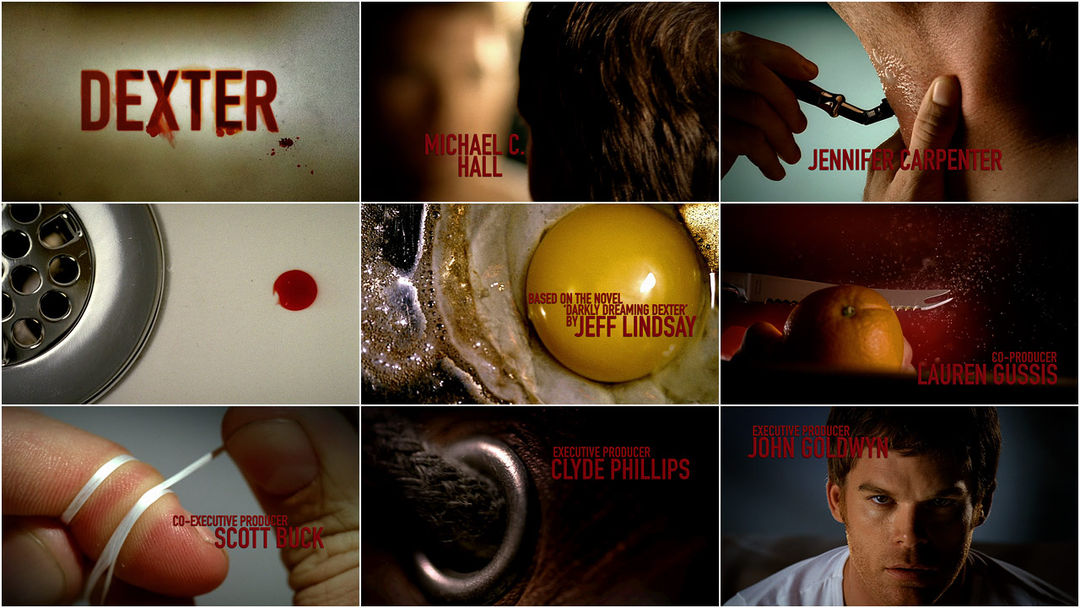
In the opening sequence of Dexter, there is a theme of violence that contrasts with the everyday routine of the character Dexter. The director has created this contrast through the use of signifiers. The first shot in the sequence is of Dexter led down; a mosquito is on his outstretched arm. He swats and kills the mosquito. This is significant alongside the saying ‘wouldn't hurt a fly’ as it links with the story line in which Dexter is a killer. This juxtaposes the meaning of the saying, which is that he wouldn't hurt anything, not even a fly. In one of the shots, a close up of a drop of blood is used. Blood is often associated with wounds and violence, however the character has actually only cut himself shaving. As this is Dexter’s blood, this might suggest that he is putting himself in danger. An alternative view may be that because the blood is in the sink, he is washing the blood from his hands. Later in the sequence, Dexter is putting on a shirt. When the shirt is pulled over his head it appears as though he is being strangled from behind. This may lead the audience to think that there are antagonistic characters who may attempt to strangle him later on in the series. There is also a close up shot of Dexter slicing some meat, the effect of the close up is that we question whether it is bacon or not. The way he forks it onto the saucepan with a knife is very carefree.
           The lighting throughout the sequence is bright and positive. Good lighting in shots are often used to suggest positive thoughts and actions. Shadows and dim lighting could have been used, however this would've made Dexter look sinister. This bright lighting leads the audience to trust Dexter and perhaps treat him as a hero not a villain despite the seemingly violent scenes. This is very important, as Dexter is not supposed to appear as a cold-blooded killer.
           In the beginning of the sequence, Dexter is shaving off facial hair. Generally a clean-shaven person is seen as a more organised and efficient person. These are characteristics which are required to be a good contract killer. Towards the end of the sequence, we see that Dexter has dressed himself in a smart but casual fashion. As Dexter is undercover and wants to remain anonymous, it is important that he dresses to fit in with society. The location for the opening scene appears to be Dexter’s home. Perhaps as a character he wants to disassociate himself from his life as a killer, so he values his morning routine as he can live his life as a normal person. As he carries out his morning routine, the audience can tell that Dexter is comfortable and composed. However when he cuts himself shaving, this may suggest that he lost his concentration and has a lot on his mind.

           The typeface for the sequence title ‘Dexter’ is a bold sans serif font. The text is red and covered in splatters of dispersing blood. The colour red has connotations of blood, anger and passion. In reference to Goffman’s theory, Dexter is presented as overtly masculine. From the sequence, we can assume he is living alone. This is reflected in his carelessness as he uses a carving knife to slice an orange.